I Work on Skeeball Machines. I'm Making a Skeeball Game. I Can't Call It Skeeball.
building a skeeball roguelite in public. design, development, trademark law, and one very nervous arcade employee.


I spend my days working on skeeball machines. The real ones. The lanes, the ramps, the sensors, the scoring rings. I know what happens when a ball catches the lip of the 40-pocket at the wrong angle. I know why the 100-hole is positioned where it is and why almost nobody hits it consistently. I know the weight of the balls, the friction of the lane surface, the exact arc that separates a clean pocket entry from a bounce-out.
I love this game. I've loved it since I was a kid feeding quarters into machines at the arcade with my dad, and I love it now that I'm the guy keeping those machines alive for the next generation of drunk bar patrons.
So naturally, I decided to make a video game about it.
And almost immediately, I hit a problem I didn't see coming.
You can't say skeeball
Here's something most people don't know: "Skee-Ball" is a registered trademark. It has been since 1929. It's owned by Bay Tek Entertainment, Inc., out of Pulaski, Wisconsin. The mark is classified as incontestable, which is a legal term that means exactly what it sounds like.
And here's the part that matters for me specifically: in 2017, Bay Tek filed a trademark registration covering computer game software for personal computers, home video game consoles, and mobile phones. That's not arcade machines. That's the exact product category my game would occupy.
So I can't call my skeeball game "skebal" which was my first choice. Not as a title, not as a subtitle, probably not even prominently in the marketing without risking a cease-and-desist letter from a company with a documented history of doing exactly that.
Which raises a question that turns out to be funnier than it has any right to be.
Try describing skeeball without saying skeeball
Go ahead. Try it right now.
"It's the game where you roll balls up a ramp into holes for points."
That sounds insane. That sounds like something you'd make up if someone asked you to invent the dumbest possible sport. But that's literally what it is. There is no other word for skeeball. It's not like calling tissues "Kleenex" where everyone knows the generic alternative exists. There IS no generic alternative. The word and the game are the same thing.
The founder of Brewskee-Ball, a competitive skeeball league that got sued for having "skee ball" in its name, tried to describe the game during an NPR interview without using the trademark. What he came up with was "a ramp-based ring toss game for kids with balls."
He knew it sounded ridiculous. "It's funny, right?" he told the reporter. Then he paused. "But it's actually not, because it's cost us a ton of money to fight this thing already."
That quote stuck with me. The absurdity of not being able to name the thing you love. The comedy and the frustration being the same emotion. That's when I realized the naming problem wasn't an obstacle. It was the game.
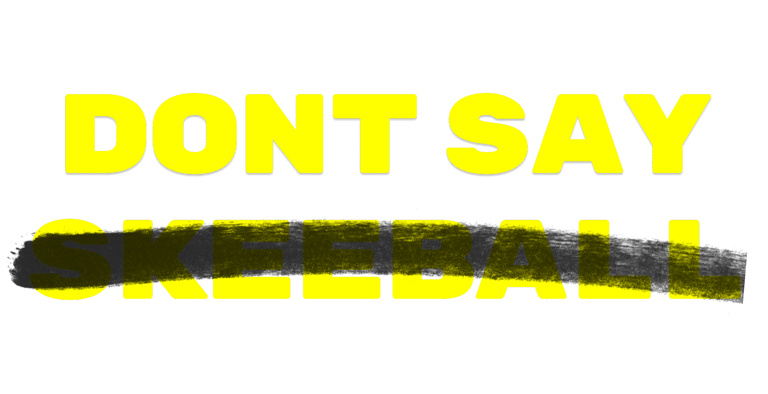
The game is called DONT SAY SKEEBALL
The title is the joke, the legal defense, and the marketing hook at the same time. It's a command. Don't say the thing. But by reading the title, you've already thought it. The name communicates exactly what the game is without technically using the trademark as a product name.
It's the same energy as "Please Don't Touch Anything" or "What the Golf?" A title that tells you the tone before you've seen a single screenshot.
The premise writes itself: you're a competitor in an underground skeeball tournament called "Not BrewSkooBall." You need to win the prize money to pay legal fees because a corporation called Boy Tak Games, Inc. is trying to shut the whole thing down. Roll balls up a ramp into holes for points in this game that is definitely not [REDACTED].
The only character is Dave, the bored arcade employee who runs the tournament out of the back of the arcade where he works. Dave is nervous about the lawsuit. Dave gives terrible legal advice. Dave constantly almost says "skeeball" and catches himself. Dave named his tournament "Not BrewSkeeBall" and genuinely thinks that's legally airtight.
What the game actually is
This is a deep roguelite with several synergistic item systems. Think Balatro meets the arcade game you're not allowed to name.
Each run is a series of rounds grouped into sets, with a boss at the end of each set. You throw balls up a ramp into pockets on a board. Real 3D physics simulation rendered through a 2D pixel art aesthetic. Every throw has weight, friction, arc, and bounce. Hitting pockets earns points. Meeting the target score advances you. Missing it ends the run.
Between rounds, you visit Dave's Redemption Counter, the shop, where you spend tickets on upgrades. Passive items that change how your balls behave. Post modifiers that reshape the board. Pocket upgrades that change how scoring works. Consumables for clutch moments. Vouchers that alter the rules for the rest of the run. Packs you can open to find new gear.
There are multiple ball types that each behave differently. Bosses that change the table geometry. Biomes that alter the physics of every throw. And a deep pool of items that stack and synergize in ways I'm still discovering during playtesting. A ball that splits on contact, passing through a post that adds fire damage, landing in a pocket with a multiplier that triggers a chain reaction across the board. That kind of thing.
You can't pull the skeeball out of this game any more than you can pull the poker out of Balatro. The physics, the systems, the comedy about not being able to say the name, it's all the one thing.
Why I'm the person making this
I'm a mechanical engineer by training. I work on skeeball machines during the day. I'm not a professional game developer. I'm learning Godot 4 in the evenings and weekends, figuring out how to turn my understanding of real skeeball physics into something that feels right on a screen.
I'm building this solo. It's going to take a while. But the design is thorough and the vision is clear. Now it's about execution.
The Brewskee-Ball story is real, by the way
The fictional premise of the game, an underground tournament getting sued by a corporation over the word "skeeball," is based on something that actually happened. I'll write a full post about this soon, but the short version:
In 2005, a guy started a competitive skeeball league in Brooklyn bars. He called it Brewskee-Ball. He says he got verbal permission from the CEO of Skee-Ball Inc. to use the name. They shook hands. No paper was signed.
In 2011, Skee-Ball Inc. sued him. The case went on for years. NPR covered it. CBS covered it. ESPN showed up. His lawyer argued that "skeeball" is a generic term, that there's literally no other word for the game. They launched a crowdfunding campaign called "Skee the People" to pay legal bills.
It settled in 2014 with a limited licensing agreement. Then Bay Tek bought Skee-Ball Inc. in 2016, the relationship fell apart, and a second lawsuit started in 2020. Over a decade of litigation across two different corporate owners, all over one word that everyone already uses.
That story, the absurdity, the affection, the legal machinery grinding against people who just love a game, is the emotional core of DONT SAY SKEEBALL. The game doesn't retell it literally. It captures the feeling of it: loving something you're not allowed to name.
What happens next?
I'm going to build this game in public. This blog is where I'll document the process. The design decisions, the physics challenges, the trademark research, the skeeball industry knowledge that nobody else writing a game blog can offer.
If you want to follow along, sign up for email updates at the top of this page. I'll send something once or twice a month, max. Social accounts are coming soon.
Don't say the name.
DONT SAY SKEEBALL is not affiliated with, endorsed by, or associated with Bay Tek Entertainment, Inc. or the SKEE-BALL brand. This is a work of parody and commentary.